LLM Performance Improvement Services:
Categories & Services
It's in the name: LLM performance improvement services are services that aim to improve how Large Language Models like ChatGPT work. The improvements, per se, are vastly diverse, covering everything from content-enhancing techniques for AI searches to LLM customization.
Before taking a look at how LLM improvement services can benefit digital marketers and help brands get more recognition on ChatGPT and other Models, let's explore this concept with a broader scope, analyzing some of the main categories it covers.
What Can LLM Performance Improvement Services Do?
"LLM performance improvement services" is as big an umbrella term as they get… To list everything these services can do would be virtually impossible, but these are some of the main categories covered:
- Model customization: This type of performance improvement requires fine-tuning Large Language Models to fit the tailored needs of companies, organizations, and individuals. If you work in finance, for example, you may want ChatGPT or Gemini to be customized in a way that makes it easier for them to perform finance-related tasks more effectively.
- Dataset remodelling: Just like LLMs can be customized to serve niche needs, they can also be improved through dataset remodelling. In short, this is a technique designed to reshape what the AI system knows by reconfiguring its dataset, i.e., the information it uses to answer user queries.
- Performance optimization: This category is also incredibly broad, but essentially refers to the technical enhancements that can make LLMs run faster and more efficiently. Optimizing API proxies, for example, is one of the LLM performance improvement services offered by specialized platforms like OptiLLM.
- RAG: Retrieval-Augmented Generation is a service that improves LLM responses by accessing external data that can improve the response's relevance.
- Prompt engineering: Refers to the creation and application of prompts that increase productivity, decrease hallucinations, and deliver quicker results. Check out the best ChatGPT prompts for some useful examples!
LLM Optimization Services For Digital Marketing
Another popular LLM performance improvement service (and the one that's most relevant to digital marketing) concerns optimizing content in order to increase a brand or business's mentions on AI searches. It's like SEO (Search Engine Optimization), but applied to Large Language Models instead of traditional search engines like Google or Bing - hence the name Generative Search Optimization, or simply GEO.
In 2025, ChatGPT already commands 9% of online searches. It may not seem like much (especially when you consider that Google dominates over 80% of global searches), but it's an impressive number for a platform that didn't exist just a few years ago! This speaks volumes about the importance of marketing-related LLM performance improvement services for increasing online visibility.
GEO services should not be mistaken for LLM performance improvement services: while they technically rely on AI optimization, the optimization does not intend to make the AI better, but rather to increase brand mentions on Large Language Models. If you were looking for this kind of LLM optimization, make sure to check our guides on AI search visibility and on how the ChatGPT ranking works.
LLM Services Cost
Whether you're looking to optimize your company's internal processes by using LLMs or make your content appear more often on ChatGPT, LLM performance improvement services tend to be a relatively high-cost solution. Here are some cost estimations:
- Large LLM fine-tuning: up to $100,000;
- RAG: From $5,000 to $25,000;
- Technical optimization: up to $3,000 per month;
- Maintenance services: between $1,000 and $10,000 per month.
Despite the relatively high cost, LLM performance improvement services can turn out cheaply by helping companies and individuals save tons of time (and money) when using Large Language Models.
Where Can You Get LLM Performance Improvement Services?
As previously stated, LLM performance improvement services include a broad set of categories, meaning LLM vendors come in all shapes and forms. They can, for instance, be the vendors behind the AI model itself (like OpenAI), or merely small label providers (like Labelbox). Anyway, here's a list of the most important service providers in the game:
- Amazon Web Services: Specializing in improvements such as more efficient resource allocation, CPU overhead reduction, and better execution paths.
- OpenAI: For fine-tuning and LLM consulting in addition to API provision.
- Azumo: They conduct expert AI evaluations and provide strategies and technical enhancements to minimize risk, ensure compliance, and increase ROI.
- Pinecone: Specializing in RAG optimization.
- Labelbox: Provides affordable services based on optimizing performance by training datasets through human feedback.
Incorporating LLM Performance Improvement Services
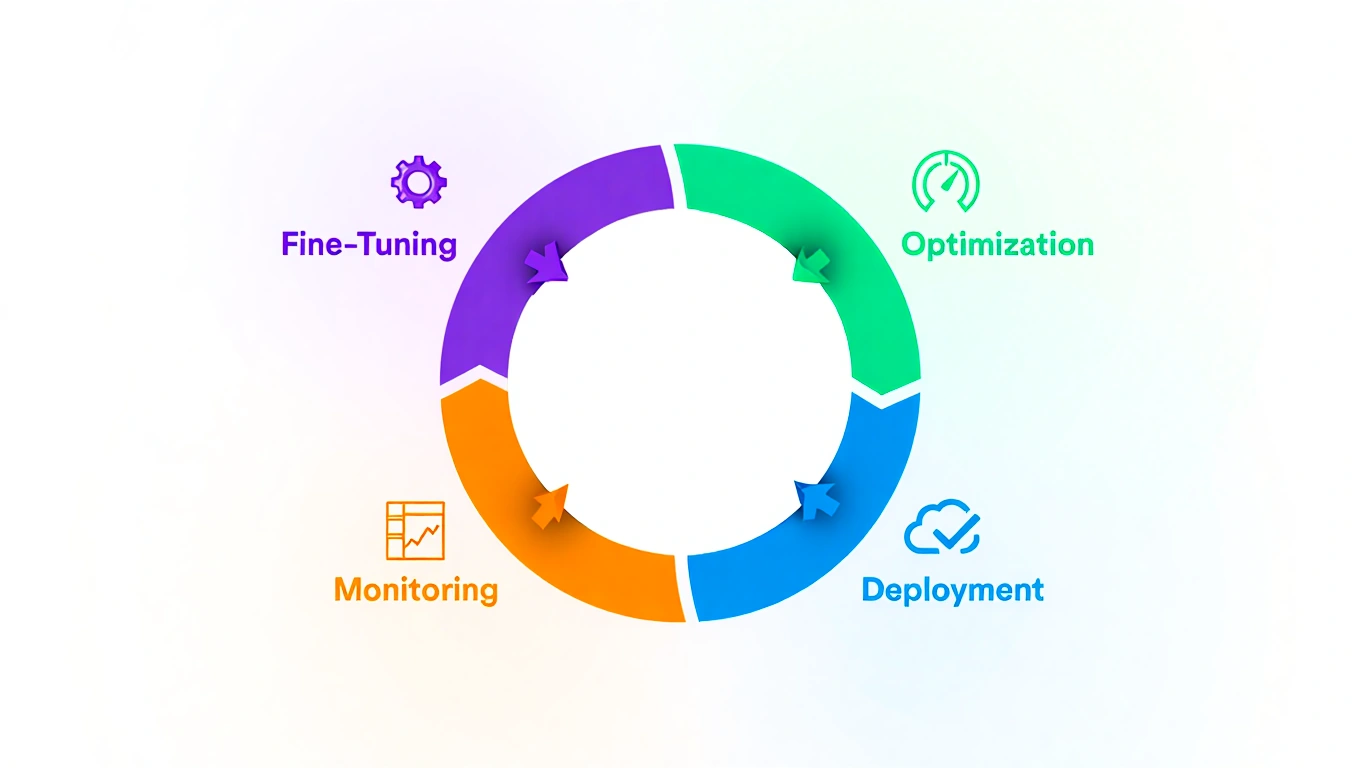
The best way to avoid mistakes when improving your brand/business LLM performance is to follow a clear, strategic workflow. Here's a suggested workflow in five simple steps:
- Define objectives: This is the most important step of all. To improve LLM performance effectively, you must first know what you want to do. Set a few success metrics and follow them diligently. If your number-one goal is to make your AI cheaper, for example, such should be taken into account every step of the way.
- Review data: If you feed your AI with bad data, its training will be significantly affected (and not in a good way). Before starting to use the AI, ensure the data you're feeding it is relevant, mistake-free, and up to date.
- Diagnose your AI: Run the first prompts and evaluate how good (or bad) your AI is currently performing. Later on, this can also help you understand exactly how impactful your LLM performance improvement efforts have been.
- Make the improvements: Start with the basics, like prompt engineering and caching, and move on to the big, complicated stuff next - evaluation scripts, add-ons, quantization, etc.
- Monitor & improve: Once you feel your AI is ready to be deployed, keep in mind that LLM performance is a never-ending task. So, don't get complacent: monitor results regularly and make necessary adjustments quickly.
LLM Services:
Do You Need Them?
The answer depends on several factors, such as:
- Your overall reliance on LLMs
- The size and scalability of your project
- The technical limitations and capabilities of the service
So, to know how beneficial LLM performance improvement services can be for you, you must make a diagnosis of the impact they can have on your organization or daily tasks.
- Do you only use LLMs occasionally? Then, maybe these services are too big an investment (at least according to current market standards) for you.
- Are LLMs an essential aspect of your day-to-day? In that case, LLM services can utterly change the way you work, boosting productivity and justifying their relatively high cost.
Either way, stay informed and keep an eye open for new LLM performance improvement services. The future of the Internet is AI, so these services are essential to stay ahead of the curve.
Key Thoughts:
- LLM performance improvement services encompass a large set of techniques designed to make Large Language Models run faster, be more efficient, cost less, or improve productivity within an organization.
- Common LLM performance improvement services include model customization, dataset remodellig, performance optimization, prompt engineering, and RAG.
- Due to the high cost, LLM performance improvement services are mainly requested by medium to large enterprises.
- Companies like Amazon Web Services, OpenAI, or Pinecone offer different types of LLM performance improvement services.
- It's essential to follow a personalized, strategic workflow plan when incorporating LLM performance improvement services into an organization.
- Investing in LLM performance improvement services makes sense if your organization strongly relies on Large Language Models.
LLM Performance Improvement Services (FAQ)
How to improve local LLM performance?
You can improve local LLM performance by using the right model format, using efficient settings, quantizing, and incorporating tools such as RAG.
How to fine-tune a small LLM?
To fine-tune a small LLM, you can either train it using custom datasets (preferably, with questions and answers) or update model weights via Quantized Low-Rank Adaptation (QLoRA).
How to make LLM responses faster?
You can make LLM responses faster by switching to a smaller model, reducing token usage (by, for example, shortening prompts), adjusting sample settings, or simply upgrading your hardware's RAM and GPU.
Can LLMs self-improve?
LLM improvement requires external, human action because LLMs can't change core weights on their own; however, LLMs can actually self-improve at a smaller level via, for example, auto-prompting or multistep output refinement.
How to reduce LLM latency?
Switching to a smaller/more efficient model and optimizing prompts by shortening their size are two of the simplest known methods for reducing LLM latency.