AI Optimization:
Definition, Tips, and Pros & Cons
The term "AI optimization" is often used to reference any technique or improvement that can be applied to AI systems. This includes, for example, building more efficient data pipelines and enhancing the system's model architecture. In the context of digital marketing, though, "AI optimization" is seen as the AI version of SEO.
In the context of digital marketing, though, "AI optimization" is seen as the AI version of SEO. Also known as Answer Engine Optimization (AEO), this type of AI optimization is all about trying to get your brand, business, website, blog, etc., mentioned on Large Language Models like ChatGPT, Gemini, or Claude.
What Can AI Optimization Do?
AI optimization is an incredibly broad term that encompasses different goals, methods, and strategies. In short, if you have used AI to make your life better, improve your business operations, or increase your AI search visibility, you have AI-optimized!
It would be impossible to list all the things AI optimization can do, but these are the fundamentals:
- It can be used to generate more effective ChatGPT prompts, maximizing the relevance and accuracy of AI responses.
- Includes the best LLM optimization practices, from fine-tuning to redundancy removal.
- It's at the basis of AI integration (i.e., when AI models are changed or optimized to fit the specific needs of businesses and teams).
- Covers LLM observability by tracking essential metrics such as latency and hallucinations.
As previously stated, the term AI optimization can also be used to describe SEO practices oriented to AI systems. In this case, the models aren't being optimized for the user; instead, the user is employing tactics to organically increase brand mentions on popular LLMs. Let's briefly analyze how SEO AI optimization works:
AI Optimization SEO Tips
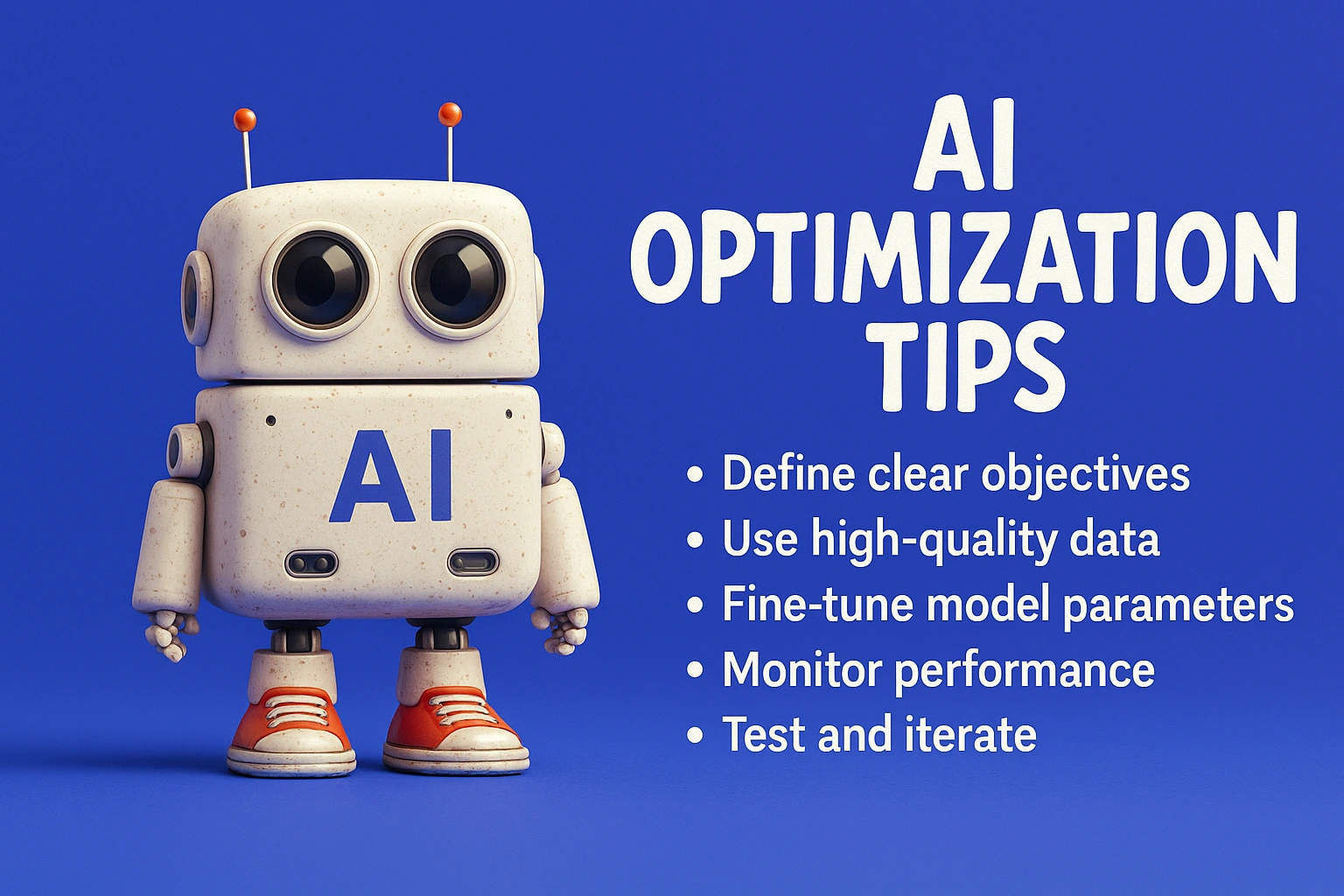
Mastering SEO isn't the same as mastering AI optimization. Because of the unique way in which LLMs resolve user queries, the best SEO practices may not be enough (or even effective at all) to get your brand some much-needed ChatGPT mentions.
These AI optimization tips, however, absolutely nail it:
- Think questions, not keywords: For your content to get cited by AI, the best you can do is try to predict questions your user base will ask LLMs and publish content addressing such questions. Keyword stuffing won't get you very far in the AI world…
- Publish on platforms that AI loves: LLMs have to get their knowledge from somewhere, and they love platforms that have high authority online, including websites like Quora, Wikipedia, and—naturally—Reddit. Get your content there, and AI crawlers won't probably miss it.
- Show consistency: If your content is consistent with your brand's products and services, there's a better chance AI will see you as an authority in your niche and mention your brand. Publishing a lot of content is a good idea, but only if such content is cohesive and authoritative.
- Use clear text structures: AI favors well-structured content that features bullet points, FAQs, and other resources for explaining concepts in the simplest, most readable possible way. LLMs themselves often resort to these resources to explain ideas to users.
- Keep it simple: AI systems aim for the simplest best answer, so you should favor snippet-style content over TL;DR articles.
For more detailed AI optimization "SEO" tips, please check our guides on Generative Engine Optimization (GEO) and ChatGPT SEO.
AI Optimization:
Pros & Cons
Taking the time to consider AI optimization is always important, regardless of the particular challenges presented by it. It's never a question of choosing between SEO and AI optimization: to excel online, your brand really needs both.
These are the main pros of AI optimization:
- It makes you appear on LLM answers and potentially reach millions of users you couldn't find via Google.
- Many people trust LLMs with no limitations, to the point of believing more in ChatGPT's legal advice than their lawyer's! That means that, if GPT happens to recommend your brand and service, people won't hesitate to buy them.
- AI search engines are a tool for the future. So, the sooner you jump on the bandwagon, the stronger your AI credibility will become over time.
As for the main cons:
- While Google can provide users with hundreds of pages per query, LLMs have limited space for your brand to be featured; this means that "ranking" on AI search engines can be much harder than ranking on Google.
- It's often possible that your brand or services will be mentioned on LLMs without a direct link to your website.
Balancing the benefits (pros) and challenges (cons) of AI optimization is key to drafting a concise strategy and gaining more visibility via AI search engines.
The Impact of AI Optimization
Whether you're using AI optimization to fine-tune LLMs or to increase your brand's ChatGPT ranking, one thing's for sure: its impact cannot be understated, especially as many expert studies and statistical reports show just how important it is.
Consider, for example, the massive macroeconomic impact of AI optimization:
- Estimates show AI adoption can add 15% to the world's GDP (in comparison with non-adoption).
- A McKinsey report states AI optimization can create up to $4.4 trillion in annual value.
- 74% of companies that invested in AI have met or exceeded expectations.
On the other hand, AI optimization can have a negative social impact by driving unemployment (especially in jobs that can be easily replaced by AI systems). According to Goldman Sachs research, the AI transition will lead to a 0.5% increase in unemployment and threaten the jobs of 2.5% of the U.S. workforce.
Professional AI Optimization Services
Considering the popularity of AI, it's no wonder AI optimization services abound, covering all types of needs of brands and businesses.
Professional GEO agencies, for instance, can help your content rank on ChatGPT and other LLMs, increasing mentions and organic AI-related traffic. But there's more, such as:
- LLM performance improvement services: Mainly focused on technical enhancements - model customization, RAG, dataset remodelling, etc.
- LLM consulting: Services providing expertise and insights to enterprises.
- LLM visibility tools: Premium online services that allow users to conveniently track AI metrics.
An Exciting New "Art Form"
To finalize, let's consider one of the key aspects of AI optimization: it's a fairly new "art form" about which little is still known. Sure, there are various learning resources to check and techniques to explore, but these are far from as established as traditional SEO techniques.
Nevertheless, it's always worth it to embrace the challenge of AI optimization, even if there are still so many things we don't fully understand about AI systems. After all, the reward is too big to ignore, especially as the future of AI seems to be increasingly promising.
AI Optimization - Key Thoughts:
- AI optimization comprises any improvement technique involving AI systems;
- However, the term "AI optimization" is often used to refer to AI SEO (aka GEO), which is about increasing brand mentions on LLMs;
- GEO differs from SEO, as it favors question-style phrasing over keywords and relies on mentions rather than page ranking;
- GEO can boost your brand's visibility by increasing mentions on well-trusted LLMs, but beating the competition can be challenging;
- AI optimization has a major macroeconomic impact, driving revenue and productivity (which is great) while also negatively affecting employment rates;
- While we already know a lot about AI optimization, it's worth considering that it's still a new art form that we don't fully understand yet.
AI Optimization (FAQ)
What does AI optimization mean?
AI optimization means improving the performance of AI systems, covering different ways in which AIs can improve a business's productivity, internal processes, and even online visibility.
What is AIO vs SEO?
AIO is about optimizing content and other technical parameters to increase mentions on AI models, whereas SEO (Search Engine Optimization) is about increasing a page's Google ranking.
What is an example of an optimization problem in AI?
The main challenges in the field of AI optimization are: problems with data inconsistency, possible AI biases, hallucinations (i.e., mistakes made by AI models), and high integration costs. It can also lead to an overreliance on AI by human workers.
How to use AI to optimize work?
AI can optimize work by automating repetitive tasks, creating structured workflows, analyzing and reviewing large datasets quickly, or monitoring metrics such as brand sentiment.
Can ChatGPT do SEO?
Yes, ChatGPT can be an extremely powerful SEO tool, especially if used in combination with professional SEO tools. Main perks include keyword research and meta title/description optimization.