8 Best LLM Visibility Tools in 2025
LLM visibility monitors how frequently your brand is mentioned on Large Language Models such as ChatGPT, Gemini, or DeepSeek. LLM visibility tools are platforms and apps designed to help users measure AI searches, but also cover other needs.
As we'll see, these tools can also be used as overall LLM optimization resources, often delivering complete strategies, content optimization options, and automated insights.
These are the 8 best LLM visibility tools of 2025:
- Ahrefs' Brand Radar
- Semrush AIO
- Profound
- Peec AI
- Surfer AI Tracker
- Rankscale
- Otterly.AI
- SE Ranking
Below, we will be taking a closer look at each of these tools.
1. Brand Radar (Ahrefs)
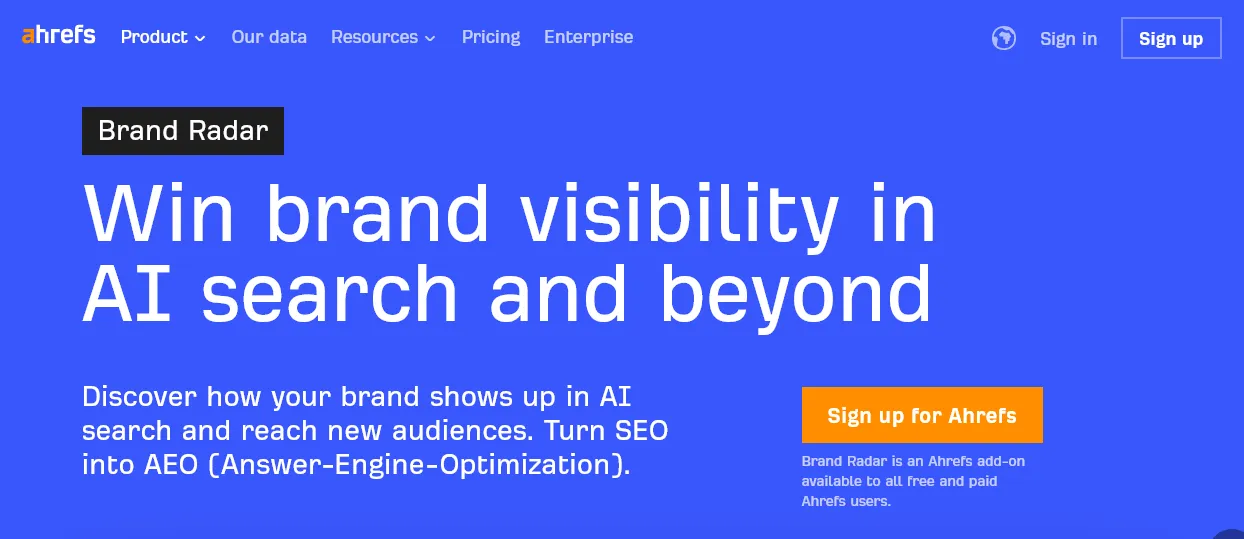
Brand Radar, a product by Ahrefs.
Ahrefs is one of the most respected brands in SEO and is well-positioned to become one of the leading AI search visibility brands. Ahrefs' visibility tool, Brand Radar, tops our list for boasting the largest AI visibility database, with 110 billion keywords and over 150 million prompts.
The monitoring resources are exhaustive, tracking metrics like AI Share of Voice, brand sentiment, and gap analysis. Content creators can use it by combining prompts by topic and identifying new opportunities. Brand Radar is also ideal for Ahrefs users, as it integrates flawlessly into the Ahrefs ecosystem and demands no learning curve.
The downside? Brand Radar is an Ahrefs add-on, meaning you have to pay for an Ahrefs plan in addition to the cost of the product.
Pros:
- The largest AI visibility database
- Complete brand monitoring resources
- Ahrefs integration
- Perfect for tracking competitors
Cons:
- Requires an Ahrefs plan
- Costly add-on
2. Semrush AIO
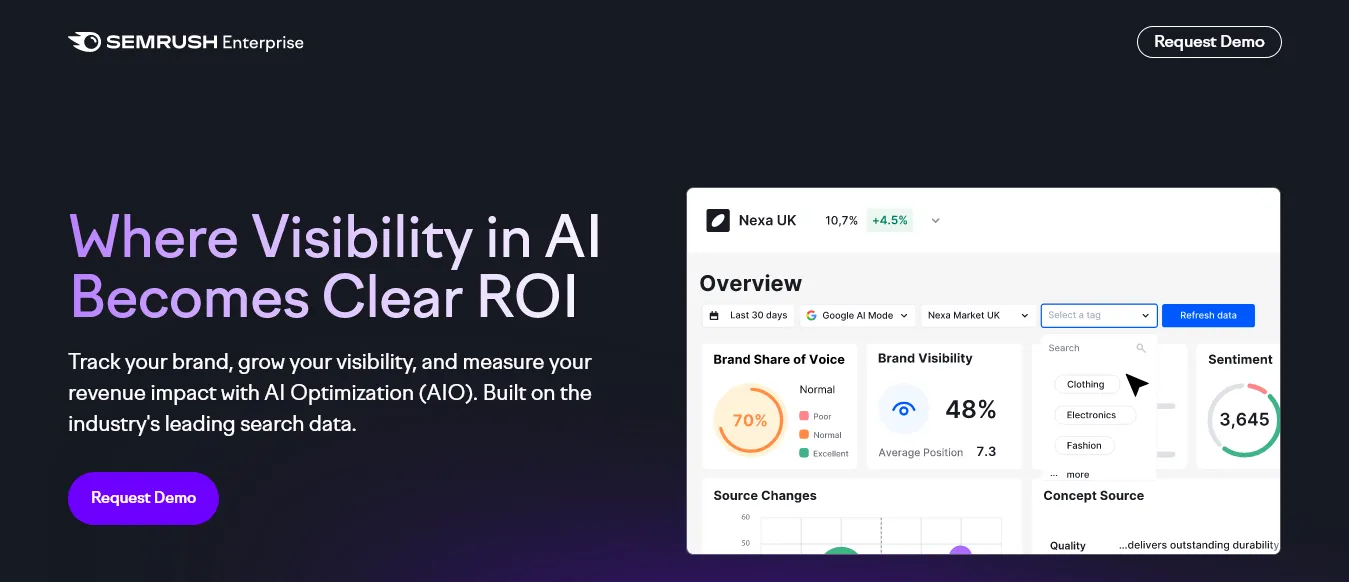
AI Optimization, a product by Semrush.
If you're planning to go big with your AI optimization strategy, it might be a good idea to consider Semrush AIO. Delivered by one of the most established brands in digital marketing (and the perennial Ahrefs competitor), AIO was designed for enterprises and is set to fit big ambitions.
The price, on request, should be too high for small budgets. However, Semrush AIO looks the part, covering metrics such as brand sentiment and keyword trends in one dashboard and delivering more than just LLM visibility - it's a complete suite for enterprises, covering everything from website optimization to content creation.
Semrush AI can also generate data-based insights, meaning it can act as an LLM visibility consultant for brands.
Pros:
- Strong option for enterprises
- Goes beyond LLM visibility
- AI visibility strategy with budget and reporting
- Impressive database
Cons:
- Not ideal for small budgets
- Still looks like a Beta product
3. Profound
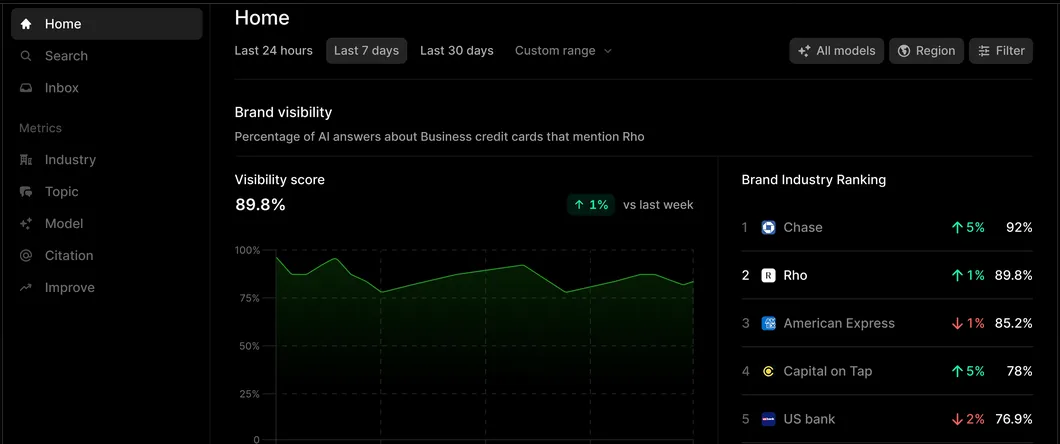
Profound LLM visibility dashboard.
Not as established as Ahrefs and Semrush, Profound is an excellent LLM visibility tool that deserves credit for its strong focus on AI-related conversions. The Shopping feature tracks product placement in AI and identifies the keywords used in prompts to discover products in your niche.
Profound can also target conversations related to your brand via prompt volumes based on keyword variations. In combination with the Shopping feature, this resource can be beneficial for fine-tuning content for AI engines, climbing the ChatGPT ranking, and outperforming competitors.
Despite offering affordable monthly plans for small companies, Profound is also an enterprise-first product, as the Starter package is limited to 50 prompts and exclusively covers ChatGPT.
Pros:
- Tracks product placement in AI
- Complete LLM visibility resources
- Workflows for optimizing content for AI
- Includes premium plans for agencies
Cons:
- The affordable packages have serious limitations
- No integration solutions
4. Peec AI
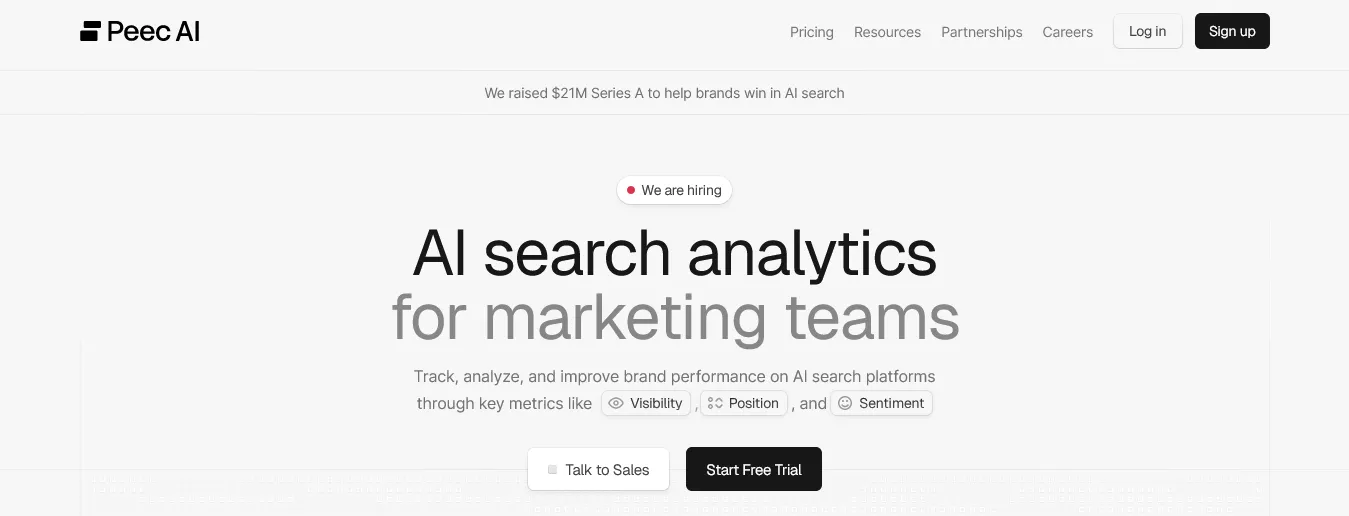
Peec AI homepage.
Peec AI is a tool that takes a refreshingly simple approach to LLM visibility and has affordable plans for small companies, marketing teams, and freelancers. Users can obtain insights and AI-suggested prompts, as well as compare AI models.
Despite being a nice tool for beginners, Peec AI tracks AI visibility, ranking position, and brand sentiment, covering all of the essentials. It's a top recommendation for mid-level projects, but scalability is possible, as Peec AI also has enterprise plans.
Peec AI only falls back to competitors for two reasons: it's still a relative newcomer with a reputation to build, and it discloses no info regarding the origin of its AI search database.
Pros:
- Accessible to small projects
- Beginner-friendly
- Designed for marketing teams
- Great for AI model comparison
Cons:
- No database information
- Not as established as some competitors
5. Surfer AI Tracker
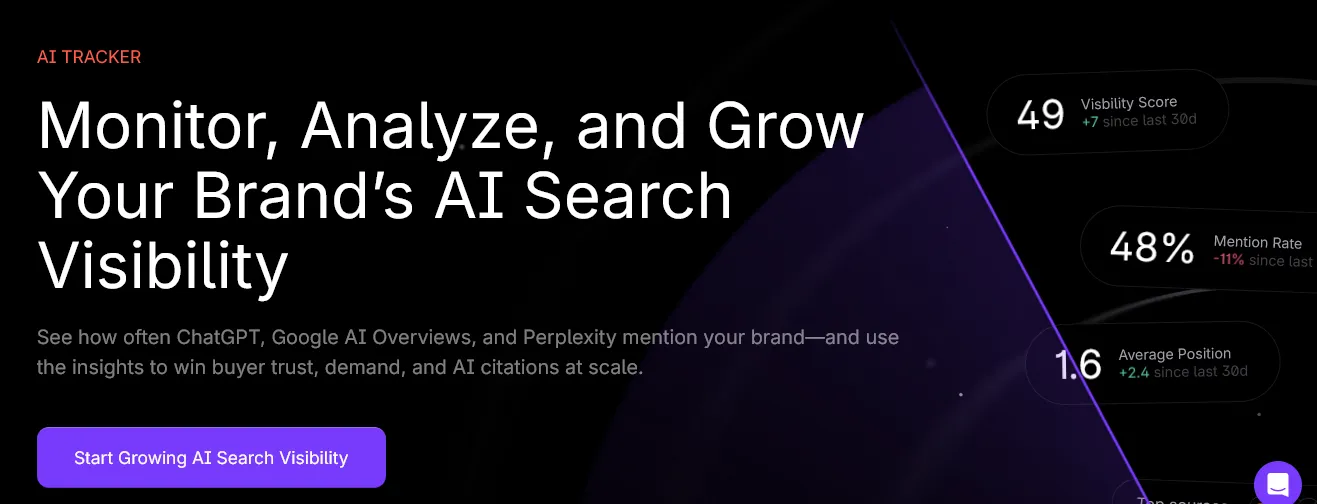
Surfer AI tracker landing page.
Surfer SEO is a well-known SEO optimization tool that has been used by content creators worldwide for years. Now, Surfer has released an AI tracker add-on focused on LLM visibility, which stands out due to its usability and added focus on brand growth.
You just need to enter a brand name, choose a topic, and select a location to identify popular related prompts and make the necessary adjustments to increase your chances of getting mentioned. Through its Insights feature, Surfer SEO gives brands a 0 to 100 visibility score - a useful, all-encompassing metric.
Some online reviews have classified Surfer AI Tracker's resource features as unreliable, but it remains one of the most solid options for content creators, especially if they're already Surfer subscribers.
Pros:
- Intuitive brand visibility dashboard
- AI visibility score
- Additional brand growth resources
- Ideal for Surfer SEO users
Cons:
- It's an add-on (requires a Surfer plan and an additional cost)
- Resource features can be unreliable
6. Rankscale
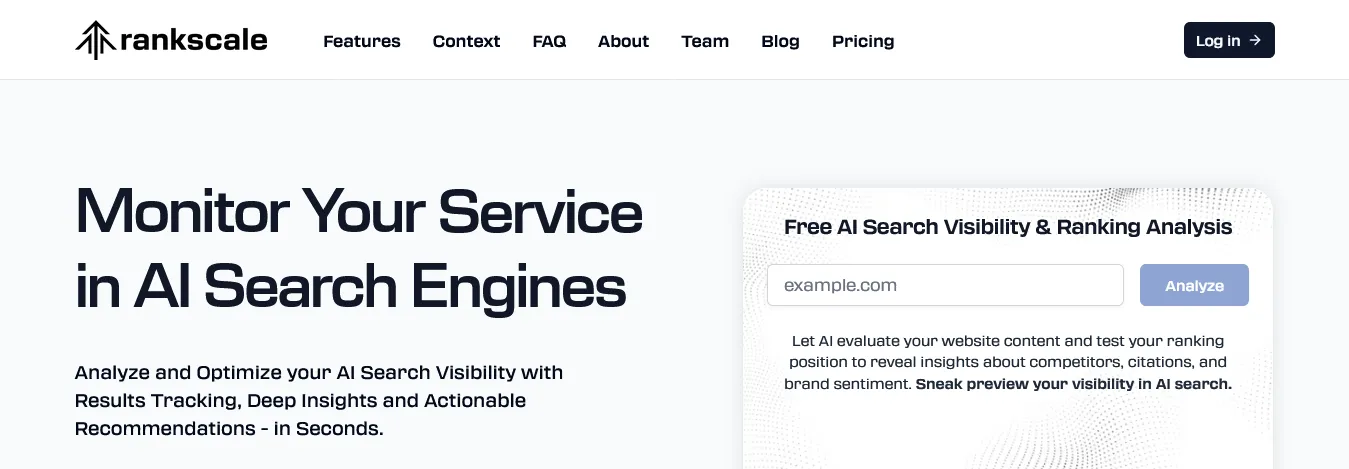
Rankscale homepage.
Rankscale is designed for Generative Engine Optimization (GEO) tracking and offers extremely flexible premium solutions for freelancers, start-ups, and enterprises alike. That's why it's called Rankscale: because it's unbeatable when it comes to scalability.
All action revolves around a "centralized GEO command center" where users can quickly access info regarding performance metrics, brand sentiment, and citation sources. They can also compare content to improve AI visibility, one of the tool's major advantages.
On the downside, expert reviews state that Rankscale cannot detect AI crawlers; its AI tracking is based on model outputs, which may not be as reliable as crawlers. This means Rankscale focuses more on AI citations and less on how AI models actually notice your content.
Pros:
- Highly scalable (from freelancers to enterprises)
- Side-by-side content comparison
- Citation & sentiment analysis
- AI readiness score (0-100)
Cons:
- Can't detect AI crawlers
- Premium plans use a credits system
7. Otterly.AI
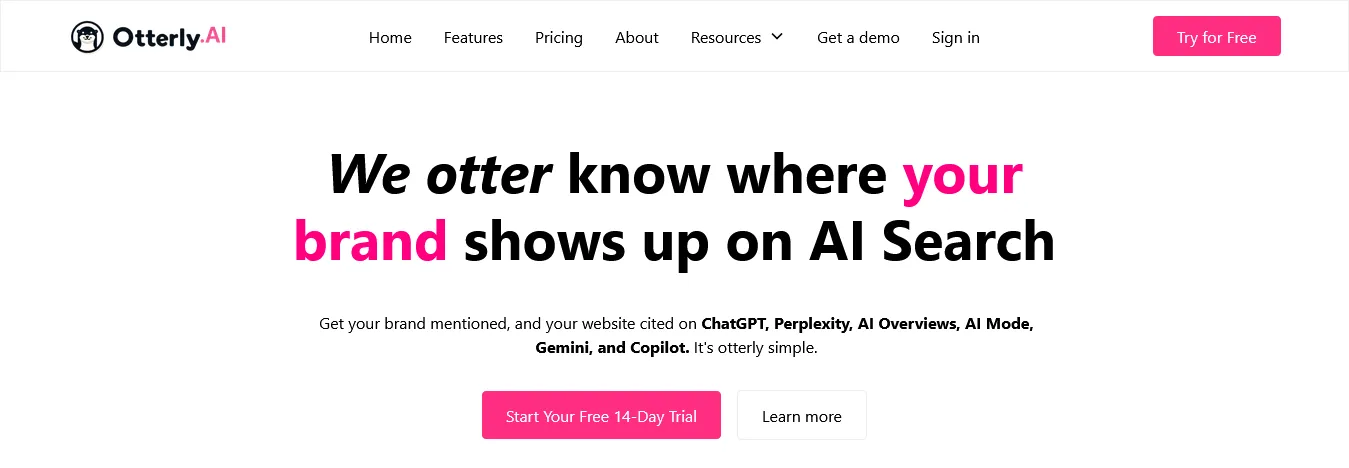
Otterly.AI homepage.
Otterly.AI states that "95% of clients" can expect measurable results after just one month of monitoring. Similar to Peec AI in many ways (transparent communication, ease of use, and affordable premium plans), Otterly is not the most complete tool on the list; yet, it offers a comprehensive set of features.
Otterly users can turn keywords into prompts, see where their links come from, track brand position and sentiment, and receive weekly reports (automated, not customized). Clients can also access a GEO audit tool that identifies strengths and fixes weaknesses.
Ideal for beginner and mid-level freelancers, marketers, and small LLM visibility projects, Otterly doesn't offer the same level of depth and complexity delivered by the top-ranking tools in our list.
Pros:
- Extremely accessible (price- and usability-wise)
- Automated weekly reports
- Has all of the basic features
Cons:
- Limited when compared to top competitors
- No integration options
8. SE Ranking
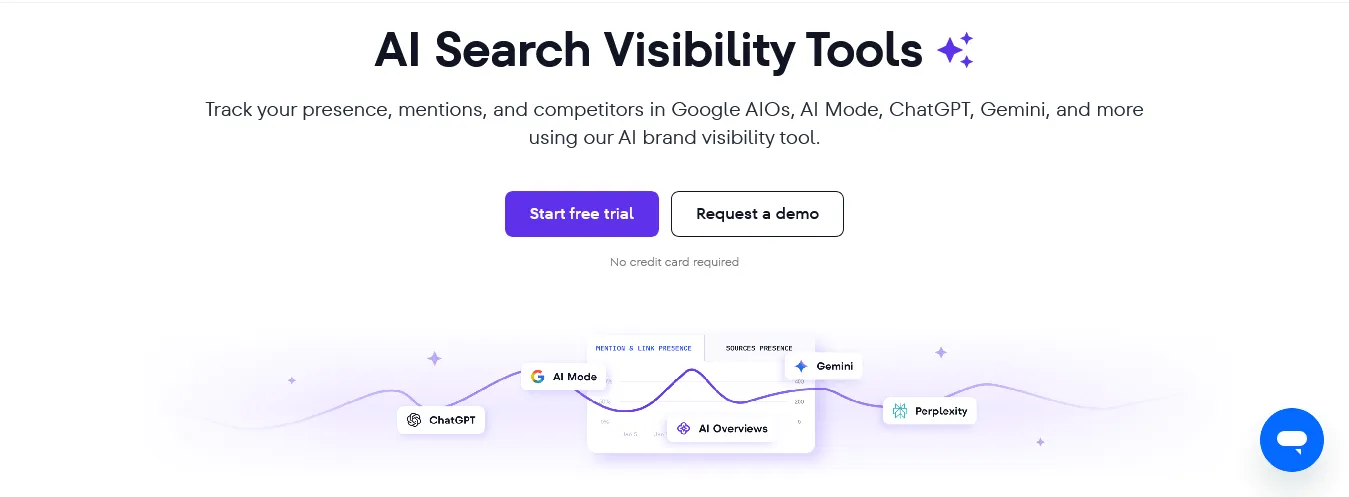
SE Ranking's AI search visibility tools.
SE Ranking remains, first and foremost, an SEO product. However, it boasts a convenient pack of AI search visibility tools that can help you boost your ChatGPT SEO. The plans are affordable, even at the pro level, but the downside is that SE Ranking is more of an AI tracker than a complete LLM visibility platform.
For this reason, SE Ranking is ideal for anyone who's still mainly focused on SEO but wants to access basic AI search metrics.
Pros:
- Good for light LLM visibility tasks
- Fair-priced premium plans
Cons:
- Only for tracking - no additional LLM visibility resources
- Mainly for SEO (GEO is an extra)
Summary
In sum, we recommend the following LLM visibility tools in 2025:
- For ambitious, enterprise-level projects: Brand Radar, a super complete tool backed by Ahrefs' stellar reputation as an SEO market leader. Semrush AIO is a strong contender, but it still needs some development.
- For product-centric projects: Profound, one of the few tools that prioritizes brand placement tracking and AI-related conversions.
- For beginners and small teams: Peec AI, combining simplicity and affordability with a respectable set of visibility features.
- For scalability: Rankscale.
- For performing light LLM-related tasks in the context of SEO: SE Ranking.
If you need some outside help to improve your mentions on AI models, consider LLM performance improvement services.