Which AI Model Should You Use?
Updated 2025 AI Model Ranking
Looking for the best AI model to use in 2025? Long gone are the days when OpenAI's GPT was the only option in the market. Currently, professionals from various industries can access several high-quality AI models, each offering unique advantages and features.
In this article, we have created an updated AI model ranking with the 10 best models of 2025 to help you make a more informed choice regarding your AI setup. Please keep in mind our choice is subjective and open to interpretation, even though we have done our best to justify our top 10 picks.
AI Model Ranking:
The 10 Best Models of 2025
Let's take a closer look at each of the models in our ranking, starting with our number-one pick: GTP-5.
1. GPT-5:
Best For All-Purpose Use
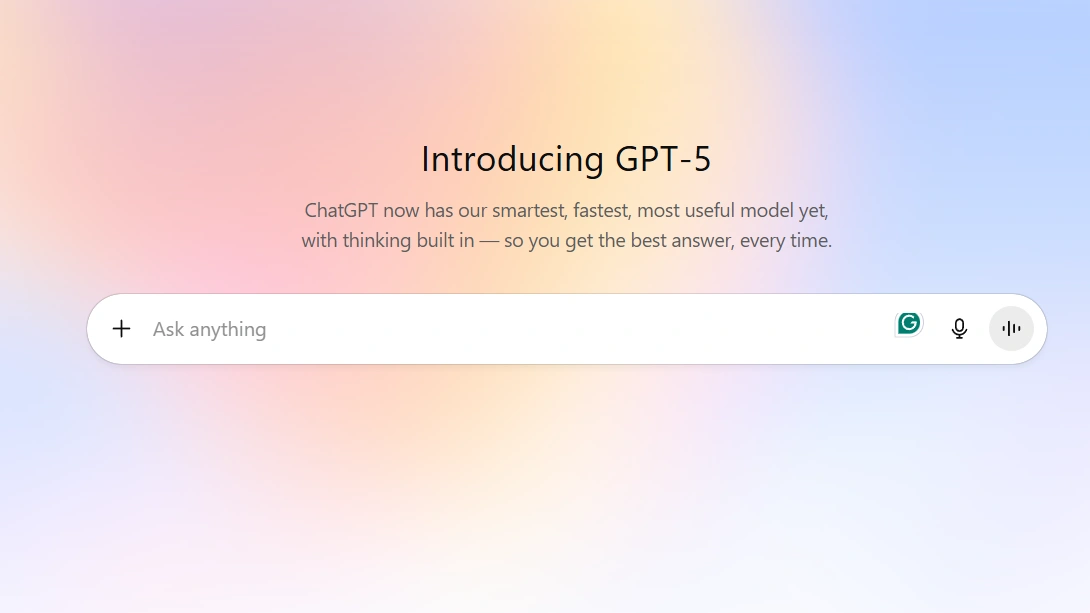
There are no limits to what you can do with an AI model. So, if you're looking for an all-purpose solution (from generating Reddit comments to learning the difference between venomous and poisonous), OpenAI's new GPT-5 is it!
Described as faster and smarter than GPT-4 (which was already great), GPT-5 is particularly improved for developer tasks and features a new mode called GPT-Thinking. This mode is used for complex tasks (such as answering deep, philosophical questions), meaning GPT-5 will actually "think" for longer than when it's answering simpler, more fact-based questions.
GPT-5 Pros:
- Ability to handle diverse tasks with the same level of efficiency;
- Fast and deep-reasoning modes;
- Reduced hallucinations (compared to GTP-4);
- Great for workflows combining multiple LLM tasks.
GPT-5 Cons:
- Cost-per-token is relatively high;
- User reviews claim auto-routing is sometimes inconsistent.
If you end up choosing ChatGPT as your favorite AI model, please don't forget to check our articles on ChatGPT SEO and the best ChatGPT prompts!
2. Claude 4:
Best For Coding
Anthropic's Claude 4 is not that popular of a mainstream AI model, but there's a good chance all your coder friends already know about it. After all, Claude 4 stands tall as the world's ultimate coding model, with the ability to work on lines of code for hours on end "without breaking a sweat".
Equally notable is the Claude Opus 4.5 update, a powerful resource for coders that delivers an entire ecosystem with programmatic tool use and workflow features. Hallucinations are deemed low, meaning Claude 4 is well-suited for corporate-level tasks.
Claude 4 Pros:
- The best for coding;
- Corporate-level tool with reduced hallucinations;
- High performance in complex reasoning tasks;
- Dynamic tool integration.
Claude 4 Cons:
- Too expensive for freelancers and small teams;
- Ethical concerns (especially regarding blackmail rollouts).
3. Grok 3:
Best For Math & Science
If you work as a mathematician or a science investigator, we recommend trying Elon Musk's Grok 3. Even though the model is far from perfect (missing the mark on creativity tasks, for example), it outperformed competitors such as GPT on math- and science-related prompts.
Grok's focus on math and science also makes it great for processing tasks involving data sourcing and analysis.
Grok 3 Pros:
- Math and science performance;
- Two modes: "Think" and "DeepSearch";
- Fast response;
- Relatively affordable.
Grok 3 Cons:
- Can be prone to hallucinations and inconsistencies;
- Unimpressive context window (only 128K, whereas some models have over 1 million).
4. Gemini 2.5 Pro:
Best For Big Projects
Google has dominated the Internet for as long as we can remember, but its AI model didn't make it to our top three. There's one thing Gemini 2.5 Pro does better than any other model, though: processing huge tasks.
If you intend to use AI models at a corporate level, for tasks as demanding as summarizing huge legal documents or producing large-scale translations, Gemini is the best "right-hand man" you can get. It also ranked number one in our list of the best ChatGPT alternatives for its strong multimodal support.
Gemini 2.5 Pro Pros:
- Top performance in long-context tasks;
- Good value for money;
- Advanced reasoning for coding and problem-solving;
- Flawless Google integration (Drive, Gmail, etc.).
Gemini 2.5 Pro Cons:
- Complex tasks may require intensive prompt design - not the best for beginners;
- Questionable image and PDF processing.
5. Qwen3:
Best For Non-English Users
Despite not being that great for complex tasks like coding (at least according to Redditors), Qwen3 stands out due to its excellent multilingual support, especially when it comes to non-English/European languages like Chinese.
Redditors also praise Qwen3's ability to "understand extremely complex prompts", but online reviewers point out significant flaws, including low creativity for writing tasks and difficulties maintaining consistency in long conversations.
Qwen3 Pros:
- Multilingual support;
- Open-source and with multiple variants (great for flexibility and LLM optimization);
- Deals effectively with complex prompts.
Qwen3 Cons:
- Not ideal for creators: poor performance in creative tasks and image/video generation;
- Ties to China raise security concerns.
6. DeepSeek-V3 & R1:
Best For Reasoning Tasks
It's hard to choose between DeepSeek's V3 and R1 models, so we're putting both in the sixth position. They deserve a place on the list because of their efficiency in dealing with reasoning-related tasks.
Why are DeepSeek models so good at reasoning? Mainly because of its MoE architecture, featuring more than one hundred times the number of parameters (over 600 billion) than active tokens (under 40 billion).
DeepSeek Pros:
- Great for reasoning-dependent tasks: coding, data analysis, large-scale tasks, and more;
- It's open-source, but performs as well as closed-source models;
- The model can be run on personal servers, ensuring maximum privacy.
DeepSeek Cons:
- User data is stored in China;
- Performs poorly on outdated devices (one of the AI models that requires the most computation power).
7. Upstage Solar Pro 2:
Best For Scaling
Not as well-known as it deserves, South Korea's Upstage Solar Pro 2 beats the competition at least at one thing: scaling. What makes the AI model so highly scalable is the use of a unique technique known as Depth-Up Scaling.
When it comes to performance across devices, Upstage is the direct opposite of DeepSeek, delivering high speed in low latency on most tasks. It's also an open weight model, meaning users can "directly access the model's knowledge".
Upstage Solar Pro 2 Pros:
- Depth-Up Scaling;
- Flawless performance across devices;
- Multilingual support.
Upstage Solar Pro 2 Cons:
- The least known AI model in the list;
- The context window is super small (only 64K).
8. LLaMA 3.1:
Best Open-Source Model
Despite its many flaws (like inconsistent responses), LLaMA 3.1 is arguably the best choice for professionals looking for an open-source model. It's backed by a friendly and helpful user community, which is another big plus.
So, if you're a developer, researcher, or startup employee, LLaMA 3.1 may be the best AI model at your disposal, at least in terms of flexibility. Since it can be easily fine-tuned, the model is also ideal for LLM performance improvement.
LLaMA 3.1 Pros:
- Open-source & available for commercial use;
- The most flexible AI model for developers and startups;
- Perfect for self-hosting.
LLaMA 3.1 Cons:
- Inconsistent responses;
- Requires flawless prompt design - not ideal for beginners.
9. Mistral Magistral:
Best For Safety
In addition to being the AI model with the coolest name, Mistral Magistral is praised for its open-source reasoning and, more importantly, central focus on user privacy and transparency.
So, if you're dealing with highly sensitive documents (like, say, confidential government reports), we recommend going for this AI model.
Mistral Magistral Pros:
- Robust safety and privacy features;
- High-performance open-source model;
- Users can trace reasoning processes.
Mistral Magistral Cons:
- High infrastructure costs (when self-hosted);
- Tracing reasoning requires advanced technical knowledge.
10. GPT-OSS:
Best For Offline Usage
OpenAI's second entry on the list, GPT-OSS is perhaps the best Open Weight model in the world. The outstanding advantage, however, is offline support: users are given full control over data, APIs, and privacy configuration.
So, if you're looking for an offline model or want to develop highly-specific solutions for your business, we suggest trying GPT's "little offline brother" ASAP!
GPT-OSS Pros:
- Offline usage;
- High MoE performance;
- Innovative MXFP4 quantization.
GPT-OSS Cons:
- Hardware requirements;
- Not the best for casual users (technical knowledge required).
Summary
These are our top recommendations for AI models in 2025:
- GPT-5: Unless you're looking for an LLM to perform specific tasks, GPT-5 is the number-one, all-purpose AI model of 2025.
- Claude 4: If you're looking for a professional coding assistant, Claude 4 is the only LLM delivering enterprise-grade solutions.
- Gemini 2.5 Pro: While we do love Grok3, we have decided to highlight Gemini 2.5 Pro instead, for its unrivalled ability to process large-scale queries.
In sum, choosing the best AI model depends on your specific needs. If you're looking for an all-encompassing solution, GPT-5 remains the safest choice.